REPORT_2: Analysis of Network Robustness

As required by the assignment, the network was subjected to various fault and attack simulations to assess its resilience. The impact of each attack was measured by calculating the Normalised Giant Component Size relative to the proportion of nodes progressively removed from the graph.
As we had a relatively small graph (approximately 1,700 nodes), we decided to remove a single node at each iteration and recalculate the values for each attack to maximise the granularity of the resulting graph. We used four different targeted attack strategies, as required:
- 0. Random failure: Random selection of the node to be removed.
- 1. Degree: Removal of the node with the highest degree.
- 2. Betweenness: Removal of the node with the highest betweenness.
- 3. PageRank: Removal of the node with the highest PageRank.
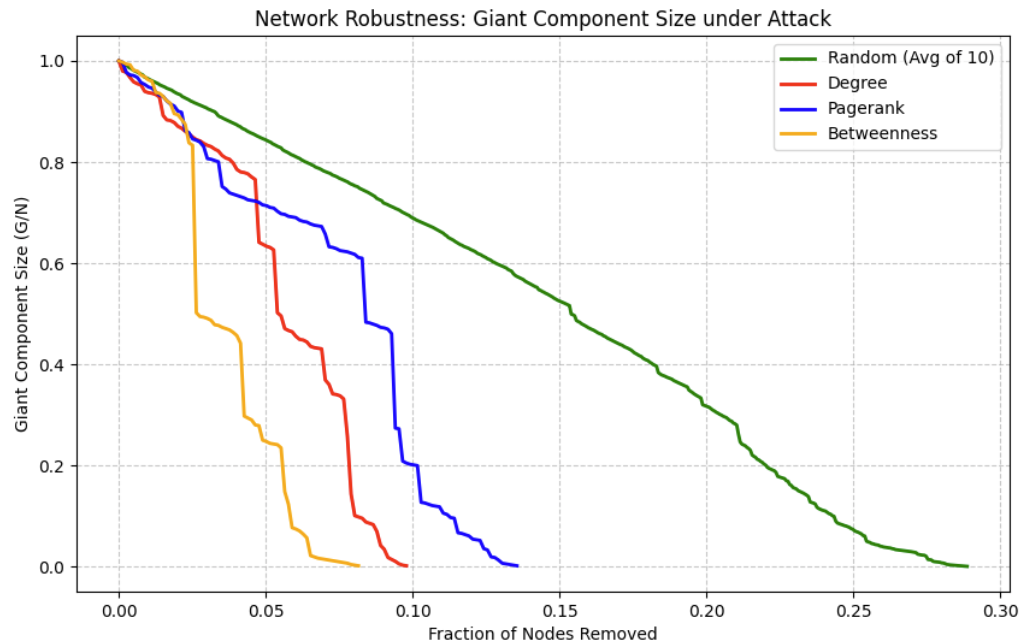
I. ATTACK STRATEGY EVALUATION
The simulation reveals clear structural differences depending on the attack strategy used:
- Random Attack (Random Failures): The network demonstrates high resilience against random failures. The decline in the giant component is almost linear, and more than 25% (approximately 27%) of the nodes must be removed before the network collapses completely.
- Targeted Attacks (Degree and PageRank): Attacks based on removing the most connected nodes (Degree) and those with the highest PageRank prove to be significantly more destructive than the random approach. By targeting high-degree nodes (such as ‘Gennaro’ or ‘ZedNode - Rocca di Papa’), the giant component asymptotically drops to zero by removing just 10% of the network.
- Targeted Betweenness Attack: This is by far the most damaging strategy for the Meshtastic network. By removing the nodes that act as radio links, the graph fragments almost instantly. The giant component falls below 10% () by removing just 6-7% of the nodes, demonstrating that the network’s information flow depends almost entirely on a very small number of critical ‘bottlenecks’.
This extreme vulnerability is likely because high-betweenness nodes (e.g. ‘Linea Gotica sixt’ with 0.1943 or ‘Monte Cosce’ with 0.1101) are mountain radio links. They do not necessarily have dozens of neighbours (low local degree), but they are the sole RF link connecting, for example, the Emilia-Romagna network with that of Tuscany.
II. INCREASING RESILIENCE
To mitigate the network’s vulnerability and improve its robustness, an attempt was made to increase the critical threshold by adding new edges. A higher value of indicates a network capable of withstanding the removal of more nodes before fragmenting.
The original network has an of 0.92122, significantly higher than that of a completely randomised configuration (), demonstrating that the actual positioning of the nodes already follows a structured, non-random logic.
Two reinforcement strategies were evaluated, creating ring connections between the neighbors of the main nodes sorted by Degree and Betweenness:
METRICS & REINFORCEMENT COMPARISON
| Graph Size | 1st Moment | 2nd Moment | Cost (New Edges) | |
|---|---|---|---|---|
| Original () | 2.46136 | 33.70366 | 0.92122 | 0 |
| Randomized () | 2.46136 | 8.39977 | 0.58552 | 0 |
| 1° ring Degree (ID: 6984) () | 2.54852 | 35.07496 | 0.92165 | 75 |
| 2° ring Degree (ID: ce4d) () | 2.60314 | 36.27542 | 0.92269 | 122 |
| 3° ring Degree (ID: 450c) () | 2.65195 | 37.58977 | 0.92410 | 164 |
| 1° ring Between. (ID: e182) () | 2.48925 | 34.38117 | 0.92195 | 24 |
| 2° ring Between. (ID: 6bb2) () | 2.52992 | 35.11214 | 0.92235 | 59 |
| 3° ring Between. (ID: 3cdc) () | 2.55084 | 35.71761 | 0.92309 | 77 |
- Strategy 1: Ring on the top 3 nodes by degree (High cost): Adding edges to the neighbours of the top three nodes by degree (ID: 6984, ce4d, 450c) increased from 0.92122 to 0.92410. However, the total cost for the three rings was extremely high: as many as 164 new edges were added.
- Strategy 2: Ring around the top-3 nodes by Betweenness (Optimised strategy): This strategy creates redundancy around the bottlenecks (the radio links ID: e182, 6bb2, 3cdc), bringing to 0.92309. The total cost of this operation was significantly lower: only 77 new edges (less than half that of the previous strategy). Even if we consider adding only the first ring around the node with the highest betweenness, this strategy costs less than half the number of added edges and guarantees a better result.
III. PHYSICAL CONSIDERATIONS ON ADDING EDGES
Whilst, in graph theory, ‘adding an edge’ is a trivial operation, in the physical reality of the Meshtastic domain it represents a significant challenge that constitutes the true ‘cost’. The 77 edges required by the 3rd Betweenness ring mean that the neighbours of a mountain node must be able to communicate directly with one another, even though they may be 100 km apart on opposite slopes.
In practice, to implement this upgrade, the Italian community can resort to three solutions:
- Hardware Infrastructure (Solar-Powered Nodes): Physically adding intermediate nodes on the peaks adjacent to the bottlenecks. This carries a very high cost in terms of hardware (solar panels, batteries) and physical maintenance, but fully maintains the network’s off-grid integrity.
- Range Upgrade (Directional Antennas): Replacing the omnidirectional antennas of certain strategic neighbours with high-gain Yagi-Uda antennas pointed horizontally towards one another to bypass the central node. This approach is subject to regulatory limitations regarding legal EIRP thresholds in the 868 MHz band.
- MQTT Uplink: Meshtastic nodes can connect via Wi-Fi to an MQTT broker on the Internet. This is the fastest and ‘zero-cost’ way to create the theoretical arcs calculated in our ring: by configuring some nodes to communicate via the Internet rather than via LoRa.
CRUCIAL TRADE-OFF
Using MQTT conceptually undermines the Meshtastic paradigm as an “autonomous off-grid emergency network”. In the event of a natural disaster and a total blackout of Italian ISP backbones—the exact scenario in which Meshtastic is designed to excel—the arcs created via MQTT would disappear instantly, causing the network’s robustness to collapse abruptly.